This is the most frustrating point in the whole story. You’ve done SEO for six months, traffic has doubled, Search Console shows lovely numbers — and the number of orders is the same as before.
First rule: don’t blame Google. If people are arriving, search did its part. The problem is between the click and the order, and that’s ground you control completely.
First check whether the traffic is buying traffic at all
Before you touch the site, check this. There are two kinds of visit:
- informational — “which is better, laminate or engineered wood”, “how do you measure a window”
- buying — “wood flooring price”, “window fitting Manchester”, “buy laminate”
If your traffic jumped because one informational article caught a thousand visits a month, sales won’t rise — and that’s normal. That article does a different job: it builds trust and brings people back later.
How to check: in Search Console, look at the queries bringing the most clicks. If none of the top twenty contains the word “price”, “buy”, “fitting”, a town name or a product name, your traffic isn’t buying traffic yet.
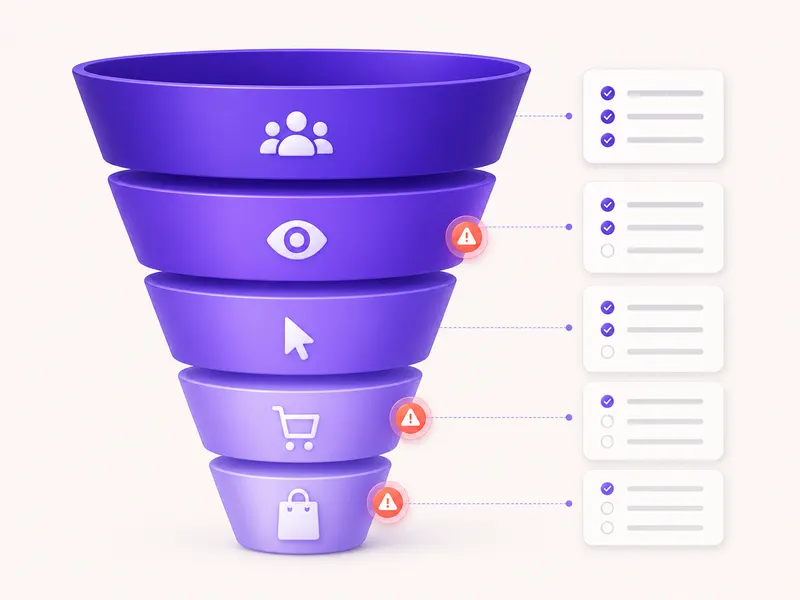
Seven places where a buyer gives up
If the traffic is buying traffic and there are no sales, work through this order. It’s sorted by effect against effort — the first items cost the least time and are most often the cause.
1. The price isn’t visible
The biggest conversion killer there is. If a page has no price, no range, not even a “from £…”, a large share of people go to somebody who did write one. Not because they’re cheaper — because they don’t require an enquiry to be sent just to learn the basic thing.
If you can’t give an exact price, give a range and an example: “fitted joinery, £180–320 per m², example: a 4 m² kitchen came to £1,150”.
2. It isn’t clear what the next step is
A page should have one clear button that says what happens when it’s clicked. Not “Learn more” but “Request a quote (reply within 24h)”. If a page has five equally weighted buttons, it has none.
3. There’s no reason to trust you
Company name, address, phone number, registration number, photos of real work, people’s names. It sounds trivial, but a site with no evidence that somebody real stands behind it loses the customer who is comparing three quotes.
4. Getting in touch is a job in itself
A form with nine fields, a mandatory “company name” for a private individual, a mandatory VAT number. Every extra field costs you a share of people. Leave a name, a contact and a message — ask the rest when they get in touch.
5. It’s worse on a phone than on a computer
Half to two thirds of visits come from phones. If the phone number can’t be dialled by tapping it, if the button isn’t visible without scrolling, if the text has to be zoomed — you’ve lost the majority.
6. There’s no answer to the question everyone has
Delivery time. Whether you come out to site. What if it doesn’t fit. Whether there’s a guarantee. Those questions get asked in someone’s head before they click on contact, and if the answer isn’t on the page, the click doesn’t happen.
7. The site is just slightly too slow
An extra second and a half on mobile isn’t consciously noticed, but it shows in the numbers. This is last on the list deliberately — it’s rarely the main cause and the most expensive to fix.
The arithmetic that shows where the money is
Take your own numbers and fill this in:
| Example | Yours | |
|---|---|---|
| Visits a month | 1,200 | |
| Enquiries / orders | 9 | |
| Rate | 0.75% | |
| Value of one job | £200 | |
| Revenue | £1,800 |
Now compare two routes to double the revenue:
- Through SEO: you need 1,200 new visits. That’s 6–12 months of work.
- Through conversion: you need the rate to go from 0.75% to 1.5%. That’s often a price on the page, one button and three answered questions — one afternoon.
That’s why the selling part of a site is always sorted out before you invest in more traffic. Every new visitor is worth twice as much on a site that knows how to receive them.
What to measure so you know it’s working
Don’t track the number of orders alone — it’s too rare an event to conclude anything from in a week. Also track:
- clicks on the phone number and on the email (set up in analytics in a couple of minutes)
- how many people reach the contact page from each section of the site
- how many started forms are never sent — if that number is high, the problem is the form itself
We cover this part with a dedicated checklist of 60+ items, sorted by what each one costs in lost sales — see what’s in it.
In short
- If traffic grows and sales don’t, first check whether the traffic is buying traffic.
- The most common cause is a price that isn’t visible, then an unclear next step.
- Fixing conversion is almost always cheaper and faster than doubling traffic.
- Measure the intermediate steps (a tap on the phone number, reaching the contact page), not just orders.