SMS marketing checklist: 32 checks before you send
Everyone opens the message. That's why a mistake shows immediately. SMS has the highest open rate of any channel and the lowest tolerance for error. This checklist walks through 32 things that decide whether people click or unsubscribe.
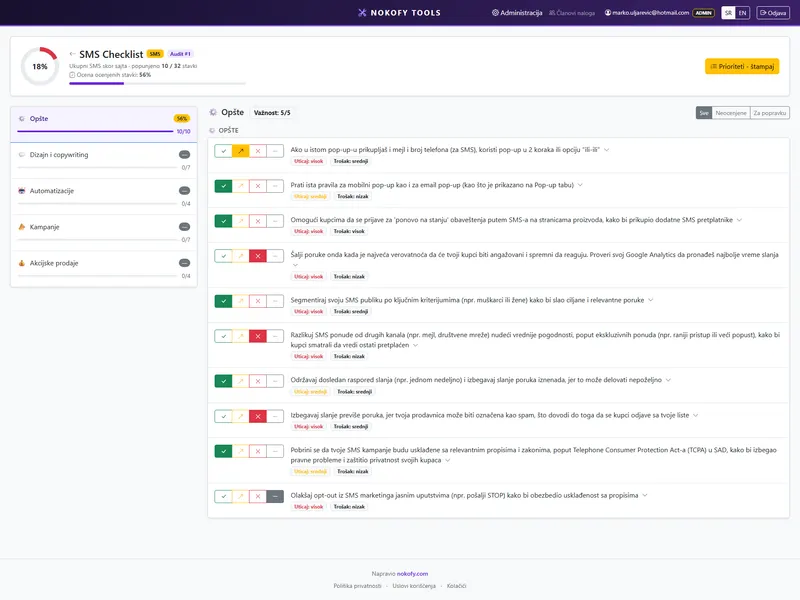
0
checks in this checklist
across 5 areas · every item explains why it matters and how to fix it
What it covers
The items are split into areas. The number beside each says how many checks it carries.
Why a checklist rather than general advice
SMS is a channel with no correction. A bad email ends up among the unread and is forgotten. A message arriving at half past ten at night, to people who never asked you to write, is remembered — and paid for in unsubscribes and reputation.
So there’s no room here for general advice like „be short and clear“. The concrete question is: do you have a record of when and how every number consented? Does the message carry your company name? Is there a way to unsubscribe, and is that unsubscribe actually honoured?
There are 32 such items, in five areas. They take fifteen minutes to work through and prevent mistakes that can’t be undone.
What one item looks like
Every item has five parts:
- The check itself — one sentence. For instance: every message contains the sender name and a clear way to opt out.
- Why it matters — the concrete consequence. With SMS that’s usually an unsubscribe, a complaint or a blocked number.
- How to fix it — the steps. What changes in the text, in the settings, or in how you collect numbers.
- Impact rating (1–3) — how much it changes the campaign result.
- Estimated cost of the fix (1–3) — a one is changing the message text, a three is changing how you collect numbers.
The items come with recommended tools, marked free or paid.
You score with four buttons: Good, Could be better, Bad, Not applicable. The last is excluded from the score — if you don’t have a shop, promotions don’t drag your result down.
The repair plan
Everything scored „Bad“ or „Could be better“ goes into the repair plan, sorted by the formula (impact + cheapness) × urgency.
With SMS almost the entire list of fixes gets solved in one day, because the cost per item is low. No code, no design — what changes is the text, the send time, and the rules about who gets a message.
So here the repair plan usually looks like a list of seven to ten items that all get done at once, before the next campaign.
It exports to PDF and CSV.
Why there’s no automatic check here
With the site checklists the tool fills in part of the scores itself, because it can open a site and read it.
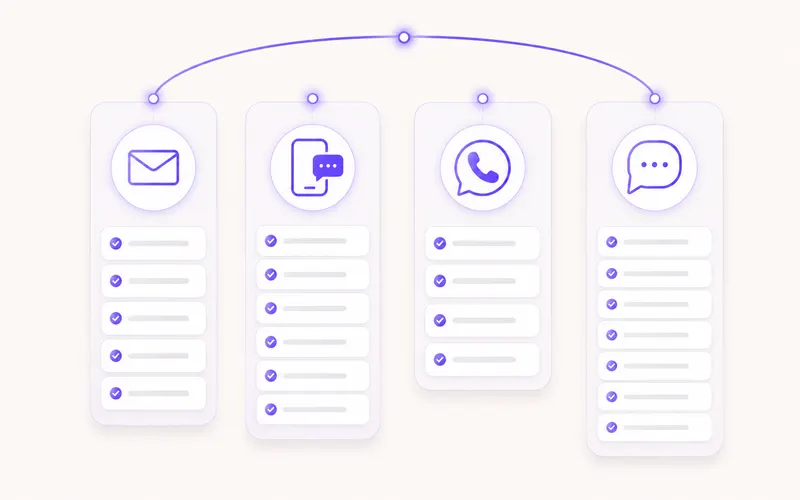
It can’t do that with your SMS sending account. It has no access to your number database, your sent messages or your delivery reports — and doesn’t ask for it. All 32 items are scored by you.
That’s hardly a burden. Thirty-two items take fifteen minutes, with your sending account open in another tab. Most answers are visible at a glance: either you have a record of consent or you don’t, either the message carries the company name or it doesn’t.
A real example
A chain of four shoe shops sends an SMS before every sale, to a base of 5,100 numbers. The last campaign: 41 orders and 180 unsubscribes.
The checklist is done in twenty minutes. Result: 11 good, 9 could be better, 9 bad, 3 not applicable.
The repair plan:
- Numbers were collected at the till, with no recorded consent to messages — impact 3, cost 2.
- The message starts with „Sale!“ and has no shop name — the person doesn’t know who’s writing — impact 3, cost 1.
- Sending goes out at 20:45 — impact 2, cost 1.
- The same text goes to everyone, regardless of whether they’ve bought in the past year — impact 2, cost 2.
The first three were fixed before the next campaign. The result of the following message: 66 orders and 34 unsubscribes. Same base, same discount, changed text and send time.
The fourth item, splitting the base by who has bought recently, went into the plan for the following month.
Honestly: SMS is the most expensive channel per message sent and the easiest to overdo. This checklist helps you use it properly, but it doesn’t answer whether it’s worth it for you at all. That depends on your margin and on how often you genuinely have something urgent to say.
Frequently asked questions
Why is this checklist so short?
Because the channel is short. SMS has no subheading, no image and no button — it has 160 characters and one link. Fewer elements means fewer things that can break, but each of those 32 carries more weight than an individual item in the email checklist.
What's the biggest mistake with SMS?
Sending to people who haven't clearly consented. Right after that: sending at the wrong time of day, and sending too often. All three are in the „General“ area and all three are fixed at no cost whatsoever.
How often is it acceptable to send?
Less often than email. The checklist doesn't give a magic number because it depends on the industry, but it gives a rule: every message must carry a reason why it's being sent right now. If there isn't one, it doesn't go.
Do I need SMS if I already do email?
Not necessarily, but they complement each other well. SMS is for what can't wait — order confirmation, delivery notice, the last day of a sale. Everything else belongs to email, which is cheaper and has more room.
The other checklists
Email marketing
205 checks
205 checks across 7 areas — from automations and newsletters to pop-ups, testing and creative.
Viber
27 checks
27 checks across 5 areas — consent, message design, automations, campaigns and account quality.
27 checks
27 checks across 5 areas — consent, business profile and messages, automations, campaigns and account quality.
Check your SMS before you send the next one
Create an account and work through 32 checks. It takes fifteen minutes and prevents mistakes that can't be taken back. The free plan asks for no card.
No card · No contract · Cancel anytime