SEO competitor analysis: the keywords they win and you don't
Your competitors are already writing your content plan. Just read it. Your competitors in search aren't the companies across the street — they're the domains fighting for the same keywords as you. Nokofy shows you who they are, which keywords they beat you on, and then pulls out a list of topics they rank for and you don't exist for.
- 2
- competitors must rank before a topic enters the master content gap
- 3-5
- competitors are worth tracking for most sites
- 4
- charts you don't have to build yourself
The problem: you think you know who your competitors are
Most people know their competitors in business. In search it’s often somebody else entirely — a news site, a blog, an aggregator, or a company from another town that simply wrote a better text.
And even when you know who they are, three questions remain unanswered.
Which keywords exactly are you losing? Knowing you’re „behind them“ isn’t enough. You need the list of keywords where you genuinely collide, and a position for each.
What do they write about that you don’t? That’s where the biggest missed traffic sits — not in the keywords you’re fighting over, but in the ones you don’t appear for at all.
How do you know a topic is even worth it? If one competitor ranks for a keyword, it might be an accident. If two or three rank, that’s no longer an accident but demand.
Without those answers you pick topics by feel. And feel is the most expensive source of data there is.
How it works
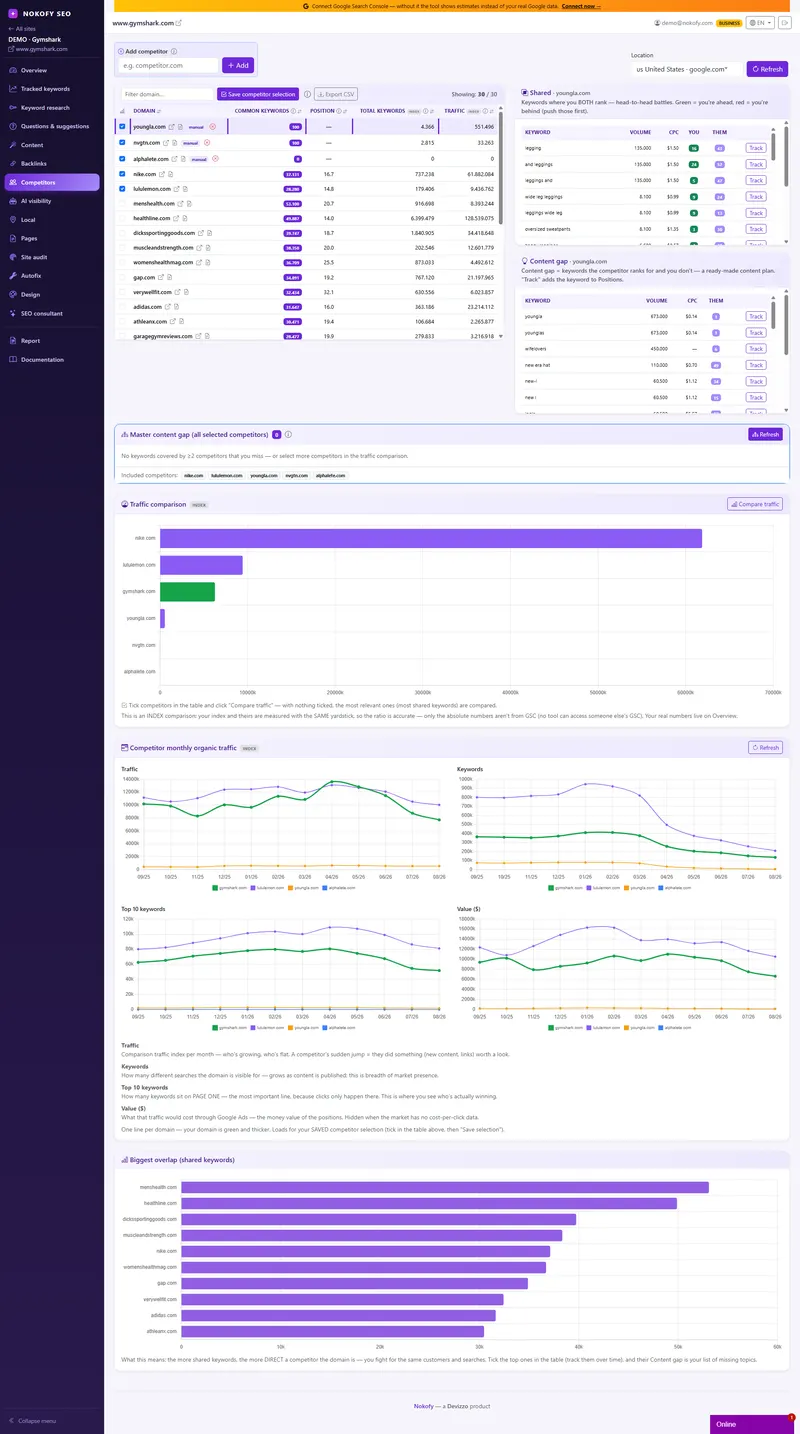
You click „Find competitors“ and the tool locates domains that share keywords with you. If somebody’s missing, or you want to track one particular company, you add it by hand. The competitor selection is remembered and applies everywhere in the tool, so you don’t repeat it in every report.
For each domain the table shows the number of shared keywords, average position, the total number of keywords they rank for, estimated traffic, a „~real“ column and the number of backlinks.
That „~real“ column is what separates this tab from ordinary estimates. Traffic estimation is crude in every tool. We calibrate it with your Search Console data — since we know how many clicks your positions actually bring on your market, we translate their positions with the same logic. The tilde stays because it’s still an estimate, but far closer to reality than a dry average.
Once you open an individual competitor, two views await. Shared keywords are the direct clashes: green means you’re ahead of them, red that you’re behind. This is where you gain fastest, because a keyword where you’re second and they’re first usually needs an existing page polished, not a new text. The content gap is keywords they rank for and you don’t exist for — every row is one topic already bringing somebody visitors from your industry.
What you get
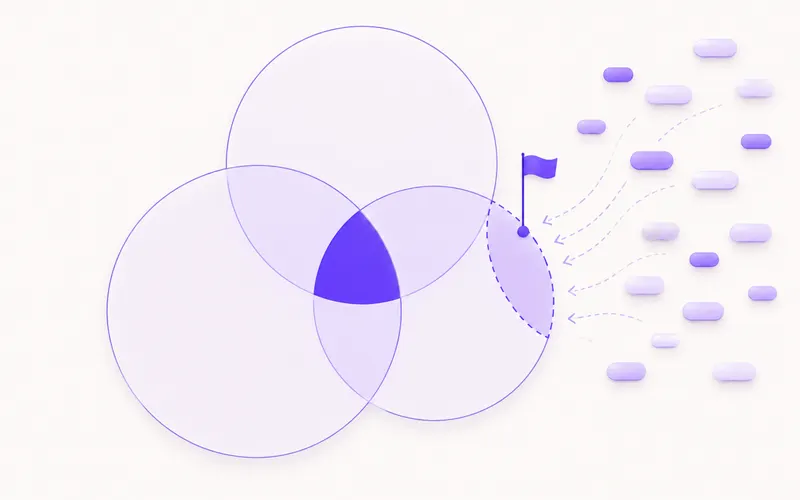
The master content gap shows keywords that at least two of your chosen competitors rank for and you don’t. The logic is simple: if two independent sites work at the same topic and both get visitors, that topic has proven demand. One competitor can get lucky, two can’t. It’s the safest list to pick your next article from, and from it you move straight into the content generator.
Alongside come four charts you don’t have to build yourself. Biggest overlap shows who collides with you most, in order. Traffic comparison shows where you stand relative to them. Competitor traffic over time follows four quantities: traffic, keyword count, keywords in the top ten and the estimated value of that traffic. Who’s rising and who’s falling is the most useful of the four — a competitor rising sharply is doing something, and it’s worth opening their content gap the same day.
You choose competitors once. That choice is remembered and used across the rest of the tool: in rank tracking, in link analysis and in reports. No re-configuring on every screen.
A real example
An air conditioning repair service in Belgrade. The owner tracks two companies he knows from the trade and is convinced they’re his competition in search.
He clicks „Find competitors“ and the list looks different. One of those two is there. The other barely shares any keywords with him. But at the top sit two sites that never crossed his mind: a home maintenance portal and the site of a larger equipment distributor that publishes instructions.
Shared keywords show where the battle is actually fought. For queries like „air conditioning service Belgrade“ he’s near the top, green. But for the queries that aren’t a direct purchase — „how often should an air conditioner be cleaned“, „why is my air conditioner leaking“, „what does this error on the air conditioner mean“ — everything is red or he isn’t there at all.
The content gap against the portal throws out dozens of such topics. The master content gap pulls out the ones covered by both the portal and the distributor, and those are the safest: two different sites getting visitors from the same question.
The conclusion is uncomfortable and useful at once. His competition in search isn’t the company that services air conditioners, but the site that explains air conditioners. The person googling „why is my air conditioner leaking“ is, a month later, the same person googling „air conditioning service Belgrade“ — except by then somebody else is already in the habit.
Who it’s for
A business owner doesn’t have to invent what to write about. The master content gap gives the list, they pick from the top.
A marketer inside a company gets „who’s rising, who’s falling“ and the traffic comparison — the strongest slide in the monthly report.
An agency or freelancer uses the content gap as a work proposal for a client with reasoning attached, instead of a hunch.
An online shop sees which categories and models it’s being overtaken on, and which topics competitors cover alongside the product while it doesn’t.
Honestly: figures about somebody else’s traffic are an estimate, and the tilde in front of the column is there for exactly that reason. Calibration with your Search Console data brings it closer to reality, but nobody on the outside has access to another company’s analytics. What is accurate are the keywords and positions — and a content plan is built from those, not from a traffic estimate.
Frequently asked questions
How does the tool know who my competitors are?
By keyword overlap. A competitor in search is a domain that ranks for the same queries as you — regardless of whether it sells the same thing. That's why news sites and blogs often turn up on the list, not only companies from your industry.
What does the tilde in front of the „~real“ column mean?
That it's still an estimate, but a calibrated one. Ordinary estimated traffic is calculated from general click tables. We adjust that estimate against your real Search Console data, so it comes closer to what actually happens on your market. The tilde stays to remind you it isn't their statistics — nobody can reach those.
What's the difference between a content gap and a master content gap?
A content gap is per competitor: keywords they rank for and you don't. The master content gap takes all your chosen competitors and pulls out only the keywords at least two of them rank for. That's a shorter and safer list.
How many competitors is it worth tracking?
For most sites, three to five. Fewer than three and the master content gap has nothing to cross-reference; more than five and the list becomes noise nobody works through.
Can I write a text for a content gap keyword straight away?
Yes. From the list you move into question research for that keyword, then into the content generator. The article arrives finished, you read it and publish it on your own site — and the moment you publish, that keyword enters rank tracking, so you can see whether you closed the gap.
Does a competitor see that I'm tracking them?
No. This works with publicly available data about positions in search.
Works together with
The tools in Nokofy build on each other — here is what naturally goes with this one.
Questions and suggestions
When you pick a topic from the content gap, this is where you get the real questions around it.
More →Content generator
Straight from a topic to a finished article with a FAQ block.
More →Backlinks
The link gap uses the same competitor selection: who links to them and not to you.
More →See who is really taking your clicks — and what they write
Create an account, add your site and click Find competitors. In two minutes you have a list of domains and your first content gap. Most people are surprised by that list alone. No card.
No card · No contract · Cancel anytime