AI visibility checklist: 56 checks across 7 areas
People no longer ask only Google. More and more often a question goes to an AI and the answer arrives without a single click on a website. This checklist walks through 56 things that decide whether it's you or your competitor mentioned in that answer.
0
checks in this checklist
across 7 areas · every item explains why it matters and how to fix it
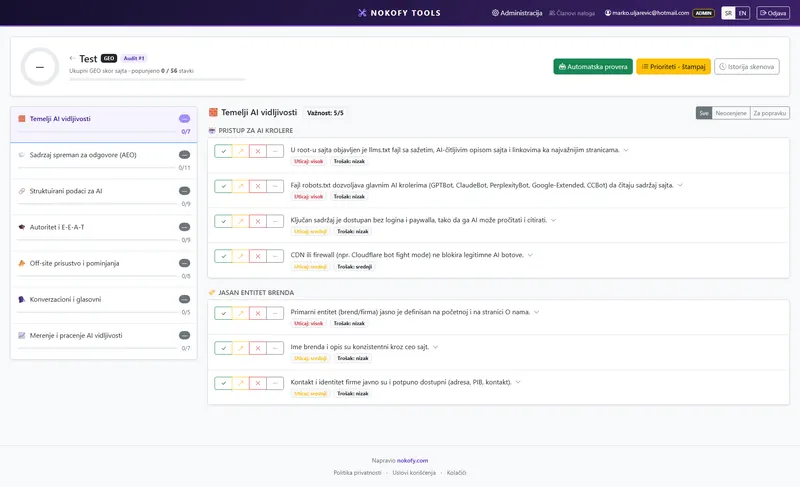
What it covers
The items are split into areas. The number beside each says how many checks it carries.
Why a checklist rather than general advice
Plenty is written about AI visibility, and very little of it is concrete. „Write quality content“, „be an authority in your niche“ — those are sentences that don’t change a single line on your site.
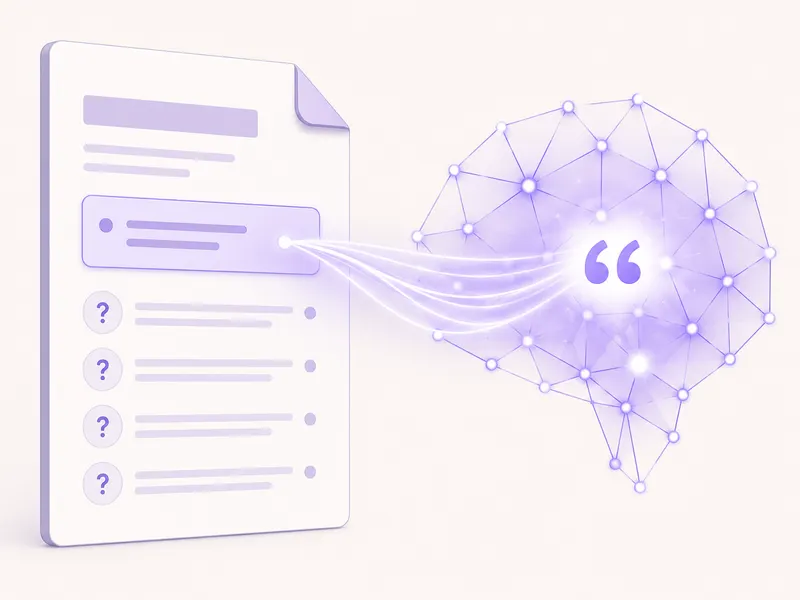
The concrete question sounds different: does your page give the answer in two sentences at the top, or do you only reach the answer in the seventh paragraph? Do your company details exist in a form a machine can read? Does anyone outside your own site mention you by name?
Those are things you can answer. There are 56 of them, split into seven areas. Not one is theoretical.
This is the shortest of our checklists, for a reason. The field is new, so we don’t pad the list to three hundred items to make it look serious. These 56 are what is known with reasonable confidence to help.
What one item looks like
Every item carries five parts:
- The check itself — one clear sentence. For instance: every page answering a question opens with a two-to-three sentence answer.
- Why it matters — what happens when it isn’t so. This states the concrete consequence.
- How to fix it — steps, not principles. What gets written, where it’s added, what it looks like when finished.
- Impact rating (1–3) — how much this item changes your chances of being cited.
- Estimated cost of the fix (1–3) — a one is rewriting one paragraph, a three is work that takes weeks.
Each also comes with a list of recommended tools marked free or paid.
You score with four buttons: Good, Could be better, Bad, Not applicable. The last is excluded from the score — if you have no physical location, items about local data don’t drag your result down.
The repair plan
Everything scored „Bad“ or „Could be better“ enters the repair plan, sorted by the formula (impact + cheapness) × urgency.
With AI visibility that formula almost always pushes content to the top, not technicals. Rewriting an introduction so it answers the question immediately costs half an hour and returns more than any change in the code. Structured data comes right after.
The plan exports to PDF and CSV.
What the tool scores instead of you
The automatic check covers around 150 checks and fills in part of the scores by itself — some of them belong to this checklist.
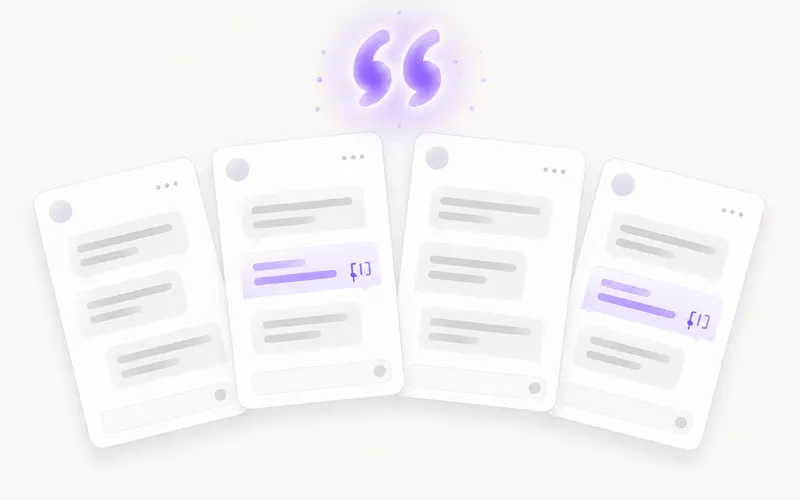
It takes a sample of pages by type: up to eight products, four categories, two text pages, the basket and the homepage, and takes two to five minutes. From them it reads what can be read from the code: whether structured data exists, how the headings are set, whether a page has a summary at the top, whether the content is available without running scripts.
Manual scores are never touched. Everything the tool fills in is marked as automatic, and when you check it and agree, you click „accept as manual“ and the score becomes yours.
What the tool can’t do: judge whether you genuinely know the subject you’re writing about, and whether anybody outside your site mentions you. That stays with you.
A real example
An accountancy firm, a 40-page site, ranking well on Google for a dozen phrases. The owner tried asking an AI „who does bookkeeping for sole traders in Novi Sad“ — four companies in the answer, none of them his.
The checklist is finished in an hour and a half. Result: 21 good, 18 could be better, 13 bad, 4 not applicable.
The first three items in the repair plan:
- Texts open with a five-paragraph introduction, the answer only appears in the middle — impact 3, cost 1.
- There’s no structured data about the company or its services — impact 3, cost 2.
- Nowhere on the site does it say who writes the texts or what experience they have — impact 3, cost 1.
The first and third were done in one afternoon. The second took two days. The fourth item, off-site mentions, went into the plan for the next three months — it’s the slowest part of the job and the checklist says so openly.
Honestly: nobody knows the exact rules here. AI doesn’t publish how it chooses sources, and it changes from month to month. These 56 items are what is known with reasonable confidence to help — not a promise that they’ll get you cited. Anyone claiming otherwise is making it up.
Frequently asked questions
What do AEO and GEO stand for?
AEO is answer engine optimisation — making your content the thing that gets cited when somebody asks a question. GEO is optimisation for generative answers, the ones an AI assembles. In practice much of the work overlaps, which is why they're in one checklist.
Does this replace classic SEO?
No. Almost everything that works for AI visibility also works for Google, but the reverse isn't always true. This is a layer above SEO, not instead of it — which is why the checklist is shorter, with 56 items instead of 280.
How do I even know whether AI mentions me?
By asking the same questions your customer would and looking at what comes back. The „Measuring AI visibility“ area has seven items about exactly that — which questions to track, how often and what to record.
Does my site have to be big for AI to mention me?
No. Small sites with clear, accurate, well-structured answers get cited more easily than large sites with general text. Clarity matters more than size here.
How quickly is the effect visible?
More slowly than with classic SEO, and it's harder to measure. This is a checklist that lays foundations — you do it once properly, then check every few months.
The other checklists
SEO checklist
280 checks
280 checks across 10 areas — from technical quality to content and authority, with a repair plan at the end.
Ecommerce checklist
461 checks
461 checks across 15 areas — from first impression and search to basket, checkout and what happens after the purchase.
Local SEO
111 checks
111 checks across 8 areas — business profile, local content, directories, reviews and tracking results.
Check whether you're visible to AI
Create an account and work through the 56 checks that decide whether AI names you as a source. The free plan asks for no card.
No card · No contract · Cancel anytime