SEO consultant that reads your whole site and says what to fix first
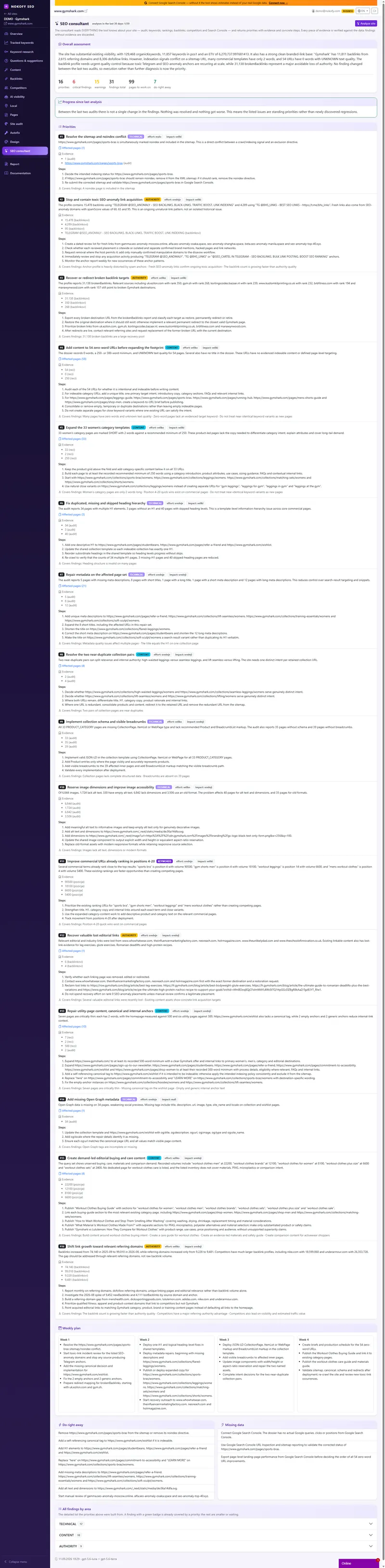
Tools give you data. A consultant gives you a decision: what the biggest problem on your site actually is, why it matters, which pages are affected and in what order to fix them — with evidence behind every claim.
- 9
- data sources feed a single analysis
- 20+
- priorities with steps, not five generic tips
- 0
- invented findings — every claim is verified against your data
Most SEO tools stop at data. You get an audit with 300 findings, a table of 150 keywords, a backlink profile with thousands of links — and then you sit down alone and try to work out what any of it means for Monday morning.
The SEO consultant does exactly that part of the job. It reads everything the tool knows about your site and writes what an experienced consultant billing by the hour would tell you: what the biggest problem is, why it matters on your site specifically, which pages are affected and in what order to fix them.
How it works
The analysis runs in two stages, the way a person does a serious review.
First, three deep passes. Technical gets every page with its problems, click depth and internal links. Content gets the word count and content score of every page, every keyword you rank for with position and volume, and the real questions people ask. Authority gets the full backlink profile, anchor texts, new and lost links, and the competitor comparison. Each pass produces a complete inventory — not a sample, not the first ten.
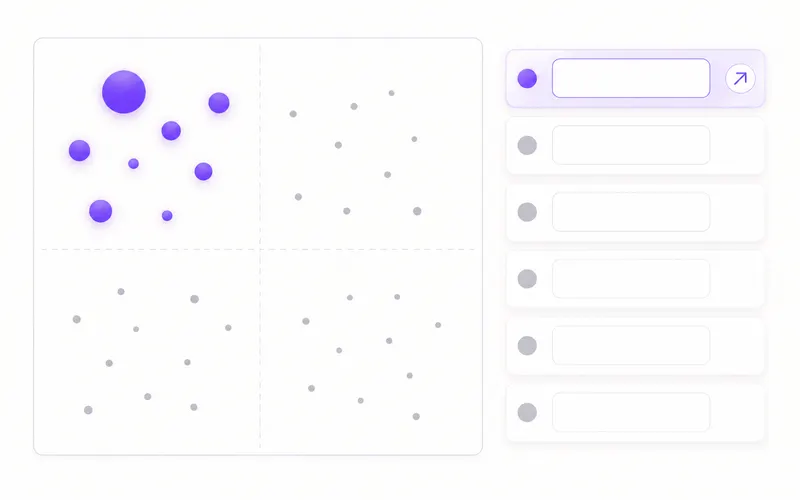
Then it is assembled into one report. Priorities are ranked by effect versus effort for your site, not by generic SEO rules. Each one states how much work it is, what effect to expect, exactly which pages are affected, and the steps.
All of it without a single new call to a paid service — the consultant works from data you already collected.
Evidence behind every claim
This is where most “AI SEO” tools fall down. A model that never checks itself will happily write a sentence that sounds clever and stands on nothing.
Here every finding must carry evidence — a page URL, a number, a value from your data. After the analysis we verify that evidence mechanically: the URL must be a real page on your site, the number must appear literally in your data. A finding without verified evidence is discarded before you see it, and the report tells you how many were dropped.
That is why the steps do not say “find HTTP resources and replace them”, but name the exact resources to change, on the exact pages.
What you get
- An honest assessment in a few sentences — including what is good, not only what is broken.
- Priorities with no artificial cap — as many as there are real problems. Similar pages are grouped into one priority with the full list of URLs.
- A weekly plan for the first month, ordered so the effect shows up fastest.
- Quick wins — things you can finish the same day.
- What data is missing — if Search Console is not connected, the consultant says so and explains what it costs you in accuracy.
- Progress since the last analysis — what was resolved, what still stands, what is new.
- All findings by area — the complete inventory the priorities came from, marked with what already made it into the plan.
A real example
A site with 423 pages. The analysis takes just under four minutes and returns twenty priorities.
Top of the list is not what you would expect. The audit reported mixed content on five pages; the consultant went further and named the exact resources causing it — and they turned out to be old links to other sites plus one feed widget, not images from the site. That is a completely different job from the one the owner would have assumed, and it takes half an hour.
Only third on the list are three pages with no internal links pointing at them, with a concrete linking plan from the homepage. Sixty-three thin texts are grouped into a single priority, with instructions not to pad them mechanically but to split them into “expand”, “merge with a redirect” and “drop from the organic strategy”.
In the keyword section the consultant stated plainly that the site tracks only three keywords and that Search Console is not connected — so that part of the analysis is necessarily weaker until that is fixed.
Who benefits most
If you run your own site and are not an SEO specialist — this is the closest thing to having someone who knows the field sit down and tell you where to start, without a hundred-euro hourly bill.
If you do SEO professionally — you get prepared material for the client conversation: priorities with evidence and a plan, instead of digging through five screens before every meeting.
If you manage several sites — each one gets its own analysis from its own data, so it is obvious where the work is most urgent.
Honestly: the consultant is only as good as the data it receives. A site with no Search Console and no tracked keywords will still get a solid technical and content analysis, but the keyword part will be noticeably weaker — and the consultant will tell you that itself instead of pretending otherwise.
Frequently asked questions
How is this different from the site audit?
The audit finds problems, the consultant decides. The audit says “138 pages are too deep”; the consultant says that is not your first job, because five pages with mixed content are dragging the whole domain down — and hands you the exact resource URLs to replace. It also looks at what the audit cannot see: rankings, backlinks, competitors and Search Console.
How do I know it is not making things up?
Because every finding has to carry evidence from your own data, and we verify it mechanically afterwards. A URL must be a real page on your site; a number must appear literally in your data. Findings that fail the check are discarded before you ever see them — and the report tells you how many were dropped.
How long does it take and what does it cost?
Three to four minutes. Every plan includes a number of analyses per month (Free 1, Pro 5, Business 20); beyond that they are paid with credits. The same audit is never charged twice — until you run a new audit, the analysis is not repeated.
What exactly does it read?
The site audit with every page and its problems, the content score of each page, the keywords your domain ranks for, tracked positions, the questions people type into Google, your backlink profile with anchors, the competitor comparison, organic pages, and Search Console if connected. Nine sources, all already collected — the analysis spends nothing on external services.
Does it see what I fixed since last time?
Yes. It also receives the previous analysis and the difference between the two audits, so the report states what was genuinely resolved, what still stands and what is new. If nothing was done, it says so plainly.
What language does it write in?
The language you use in the tool — Serbian or English. Data values (page URLs, keywords, search queries) stay exactly as they are, because a query is what people really type.
Works together with
The tools in Nokofy build on each other — here is what naturally goes with this one.
Let the consultant read your site
Add a site, run an audit and click “Analyse site”. In a few minutes you have a list of priorities with evidence and a plan for the month.
No card · No contract · Cancel anytime