AI visibility in ChatGPT, Gemini and Google AI Overview
When a customer asks an AI for a recommendation — are you in the answer? More and more people don't open Google and ten links; they ask an assistant and take the first suggestion. Nokofy puts your questions to all four assistants and shows whether they cite you, merely mention you, or leave you out — and who they recommend instead.
- 4
- assistants: ChatGPT, Gemini, Perplexity and Claude
- 100
- points for a citation, 50 for a mention, 0 for absence
- 0
- extra cost — AI visibility is in the plan
The problem: you rank on Google and the customer still doesn’t see you
Until recently the job was clear: be in the top five results and the clicks arrive. Today a finished answer increasingly appears above that list — or the search doesn’t happen on Google at all, but in a conversation with an assistant.
Somebody types „recommend a good dentist in Niš“ or „which air conditioning service should I call in Belgrade“. They get three names and a paragraph of explanation. For them, at that moment, the other twenty companies don’t exist — not because they’re worse, but because the model didn’t name them.
That creates three new blind spots. You don’t know whether you’re mentioned: no report, no position, no number. You can open an assistant and ask once, but tomorrow the answer is different, and in English it’s different again. You don’t know who is recommended instead of you, even though that’s measurable too. And you don’t know whether the assistant can read you at all — a site can be technically closed to AI readers without the owner having any idea.
How it works
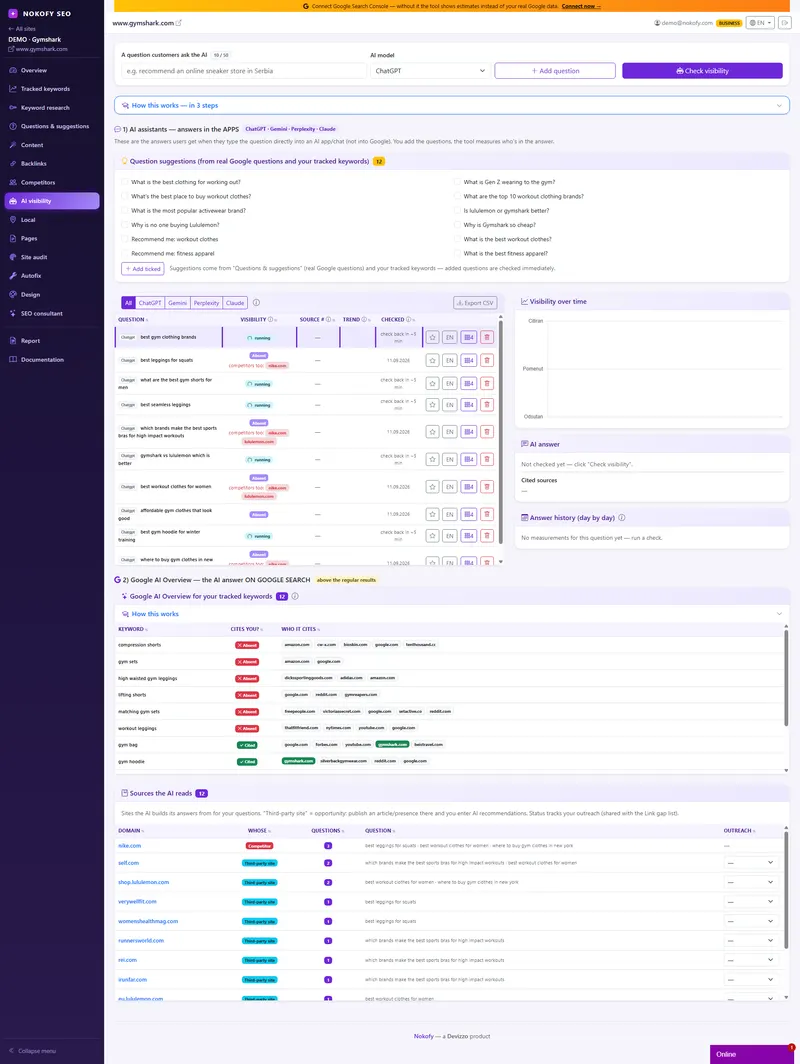
You type in questions the way a customer would put them to an assistant. You don’t have to invent them: the tool suggests questions drawn from real Google questions and from the keywords you already track.
The same question then goes to ChatGPT, Gemini, Perplexity and Claude. You run the check across all four models at once, because answers differ from model to model more than people expect.
You read the result by colour. Green means you’re cited — the assistant names you as a source or a recommendation, and that’s the goal. Amber means mentioned: your name appears, but you aren’t the recommendation. Grey means you’re not in that answer at all. Next to the row sit red badges with the names of competitors the assistant recommends instead of you — the most useful part of the screen, even if it’s the most uncomfortable.
Below the colour comes the depth: sentiment, with a warning if an assistant mentions you in a negative context (worse than not being there), the cited sources the model pulled its claim from, day-by-day answer history and the list of competitors in the answer. Business checks priority questions daily, Pro weekly, the free plan by hand when you click. For every question you can also create an EN duplicate — the same thing in English, measured separately.
What you get
AI Share of Voice is a single number summing all your answers: cited is worth 100, mentioned 50, absent 0. Instead of „it feels like they mention us less“ you get a curve that rises or falls. It’s the one figure in this area you can put into a report with a clear conscience.
Google AI Overview is the second section of this tab. For keywords you already track you see whether an AI answer appears above the results, whether it cites you, and who it cites if not you. This arrives from the regular position checks and doesn’t consume separate ones, since the same search is being looked at anyway.
The „Sources the AI reads“ table says, for every domain appearing as a source, whose it is — your site, a competitor or a third-party site — and in how many questions it shows up. Third-party sites are the most valuable information here: if an assistant keeps citing one portal or directory when answering questions from your industry, that’s a gateway. Establish a presence there and you enter the circle the model pulls recommendations from. That’s a concrete task, not „work on the brand“.
And the part few people explain: assistants don’t invent sites, they search — but they don’t all search the same place. ChatGPT searches the Bing index, so the number of your pages in Bing directly decides whether ChatGPT can find you at all. Gemini and Google AI Overview read Google. Perplexity has its own crawler. Claude has its own search. The second brake is robots.txt: if it blocks AI readers — and many sites have that switched on, sometimes without the owner knowing — assistants literally cannot read your content. A site they can’t read is a site they can’t recommend.

A real example
A dental practice in Niš. On Google it stands excellently for „dentist Niš“ and the owner is happy.
He adds five questions the way a patient would put them: „recommend a good dentist in Niš“, „where can I get an implant in Niš“, „how much does a dental implant cost“, „best orthodontics Niš“, „children’s dentist Niš“.
The first check is unpleasant. Two assistants show grey, one amber, none green. Next to every row sit red badges with the names of two competing practices the assistants recommend.
The first finding comes from the sources table: the assistants keep citing one local portal and one healthcare directory. On neither is there a profile for the practice, or the profile is empty. That’s an afternoon’s work.
The second finding comes from the Bing section: the site has considerably fewer pages in the Bing index than in Google’s. That’s why ChatGPT wasn’t finding it at all — it wasn’t bad, it was absent from the index that assistant takes its data from. One click on the button that pushes pages into Bing.
The third finding is from the EN duplicate: for the English question the answers are different, with different companies. For a practice that also takes patients from abroad, that’s a separate market.
Not one of those three steps was writing content. All three were the same thing: being present where the model reads from.

Who it’s for
A business owner gets the simplest check there is — ask as a customer and see whether you’re in the answer.
A marketer inside a company gets AI Share of Voice, a number a boss understands without explanation: it rises or it falls.
An agency or freelancer gets a service competing agencies don’t offer yet, and clients are already asking about.
An online shop tracks product recommendations and comparisons, increasingly asked of an assistant instead of a search engine.
Honestly: one measurement here means nothing — answers vary from day to day, so you watch the trend, not a single check. But one thing is worth saying: with our competitors, AI visibility tracking is a paid extra — Surfer charges $158 a month, SE Ranking $71–89 a month, and Semrush keeps it in the more expensive plans. With us it’s in the plan, with no surcharge.
Frequently asked questions
What do AEO and GEO mean?
They're names for the same job: optimisation for answers (AEO) and for generative search (GEO). The point is that the target is no longer only a position in a list of links, but being the source an answer is assembled from.
What's the difference between „cited“ and „mentioned“?
Cited means the assistant names you as a source or a recommendation — that brings a visit and trust. Mentioned means your name appears in the text but you aren't the recommendation. That's why in AI Share of Voice a citation is worth 100 and a mention 50.
Why are the answers different every time?
Because assistants aren't a table but a generated answer — they vary from day to day and from model to model. That's exactly why there's day-by-day history and automatic checking: one measurement means nothing, the trend means everything.
What does Bing have to do with ChatGPT?
Everything. ChatGPT searches the Bing index, so if your pages aren't in Bing there is nowhere for it to take you from — however well you stand on Google. Gemini and Google AI Overview read Google, Perplexity has its own crawler, and Claude its own search. The tool shows you the state of the Bing index and has a button to push pages into Bing.
Why is the question duplicated in English?
Because the answer in English is often completely different, with different companies and different sources. If customers also come to you from abroad, those are two separate markets and they're measured separately.
Can I influence what the AI says?
Not directly — there's no button that writes you into an answer. But you can influence the input: that assistants are allowed and able to read you (robots.txt, Bing index), that you exist on the sites they cite as sources, and that your pages clearly answer the questions being asked.
Works together with
The tools in Nokofy build on each other — here is what naturally goes with this one.
Search Console and Bing
The state of the Bing index and submitting pages to Bing, where ChatGPT searches.
More →Site audit
Checks whether robots.txt blocks AI readers and whether the content is readable.
More →Tracked keywords
Google AI Overview for your keywords comes from the same position checks.
More →Ask one question the way your customer would — and see if you're in the answer
Create an account, add your site and type the question a client would put to an assistant. Within minutes you have answers from four models and a list of companies recommended instead of you. No card.
No card · No contract · Cancel anytime