
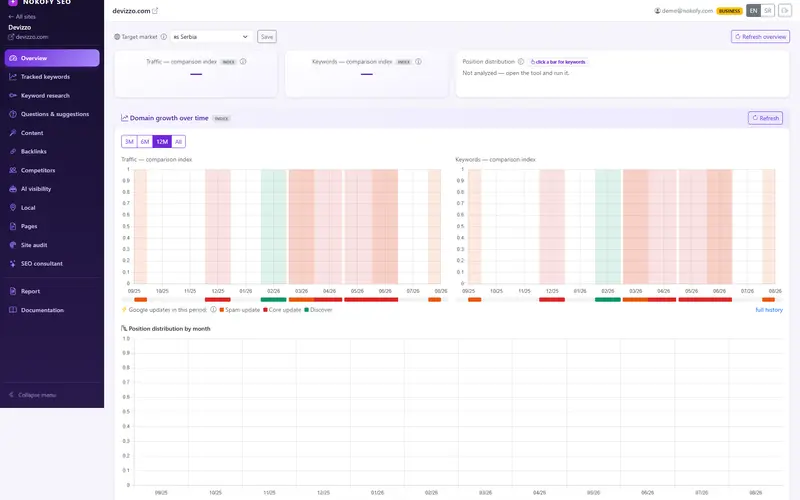
Site overview
The widest view of the site: estimated traffic, real Search Console data, how your positions are spread out and a list of what to do next.
- Domain strength 0–100
- Measured vs estimated
- Core Web Vitals from real visits
- What to do next
The tool that doesn’t just tell you what’s wrong — it fixes it automatically.
Sixteen tools and 1,200 checks in one account — instead of ten subscriptions, ten logins and ten invoices. An SEO consultant analyses the whole site, connects the findings and states plainly what to fix first and why, writes a complete article for the keywords you pick, and the errors the audit finds are fixed automatically on your site.
Free plan · No card · Local Google data · 48 languages
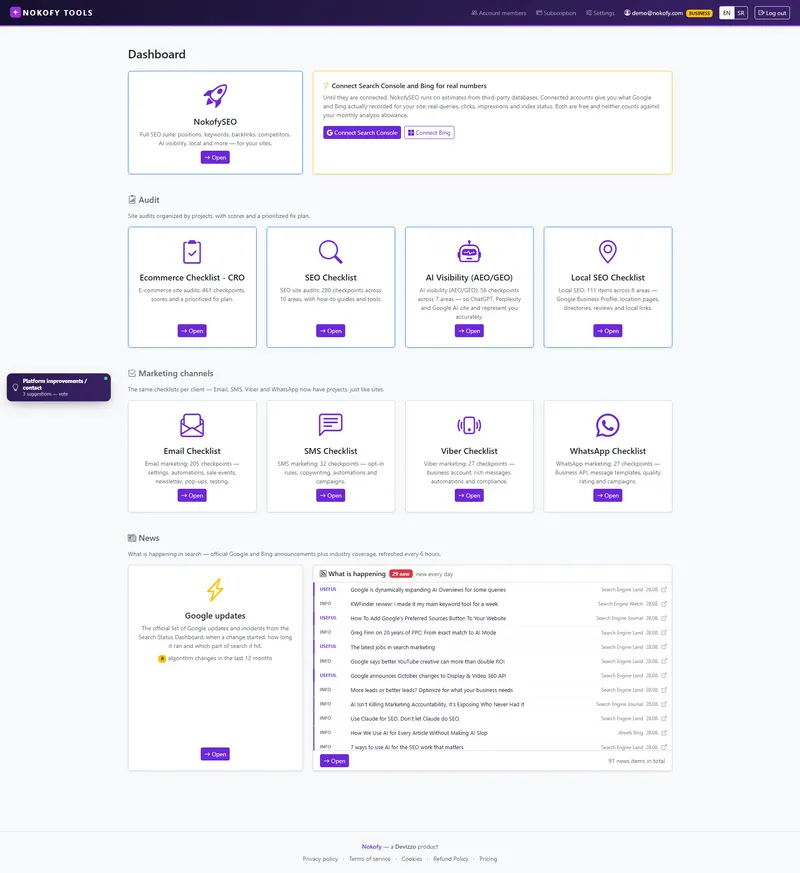
It's a platform that covers the whole job around a site: rank tracking and keyword management, the most detailed audit down to the smallest error, real Google questions and suggestions, keyword research, competitors, backlinks, local search and AI visibility, plus the most detailed checklists on the market — and article writing you only review and publish.
See all sixteen tools →It replaces
Ten subscriptions, ten logins and ten invoices — or one account.
Why Nokofy
We aren't building another tool for one thing. Nokofy covers the whole job around a site — from what people search for, through writing and auditing, to rank tracking and a report for the client. All in one account, in 48 languages.
The widest view of the site: estimated traffic, real Search Console data, how your positions are spread out and a list of what to do next.
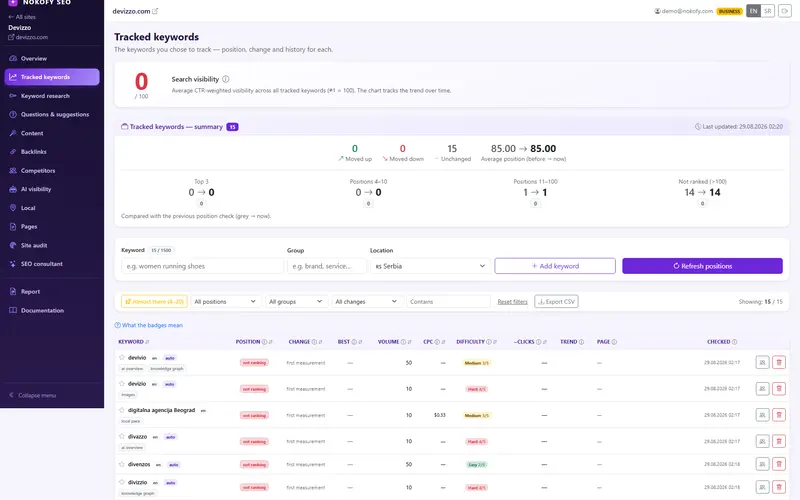
Your position for each keyword over time, with history, trend and average. See where you're close, where you're losing clicks and who is above you.
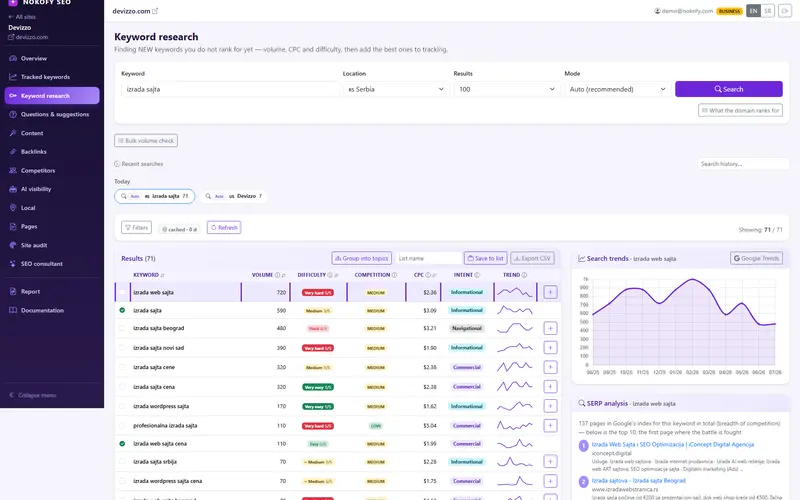
Finding new keywords you don't rank for yet, with bulk checking of up to a thousand keywords at once.
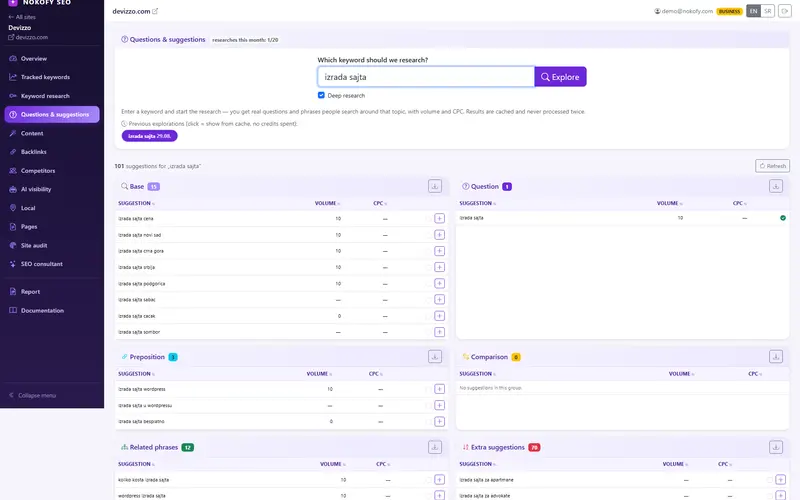
Our edge: the real questions people type into Google, with search volumes — from a database of our own that grows every day. Plus a button that writes the article answering them straight away.
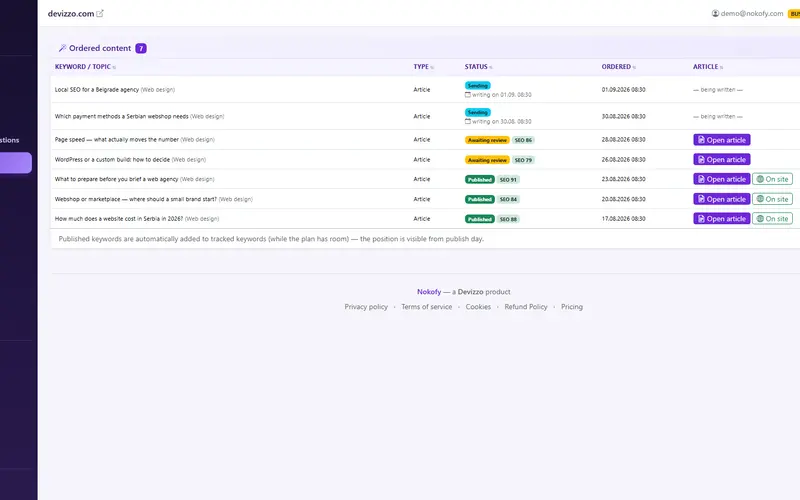
The article is written in six steps, with images and structured data. You read it, polish it and publish it on your own site.
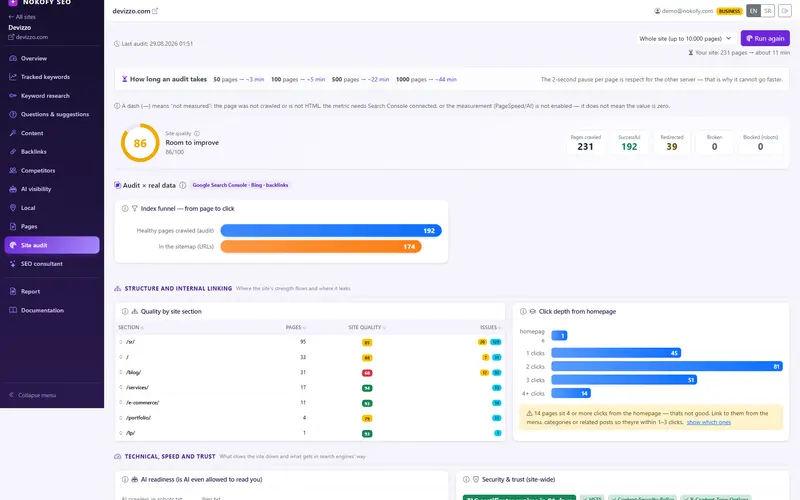
We go through the whole site down to the smallest errors and tell you what is costing you most — cross-checked against real clicks.
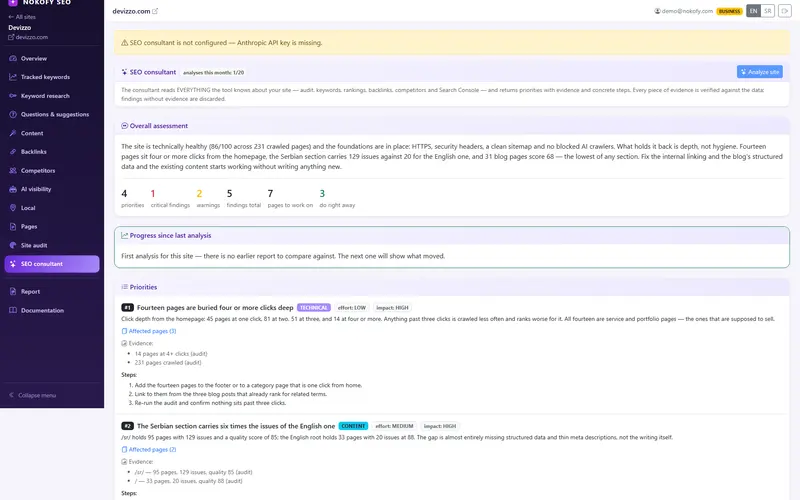
Reads your entire site — audit, keywords, rankings, links and competitors — and tells you what to fix first, with evidence behind every claim.
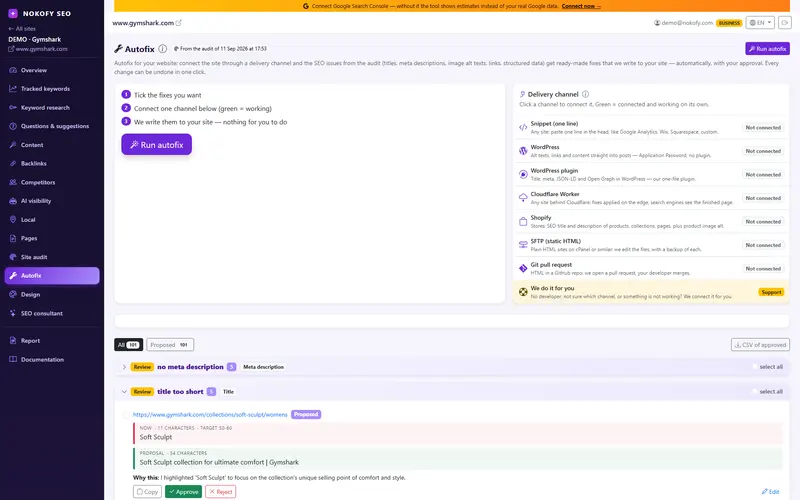
The tool writes the title, meta description, alt text, structured data and links for every finding — you approve, we write them to the site.
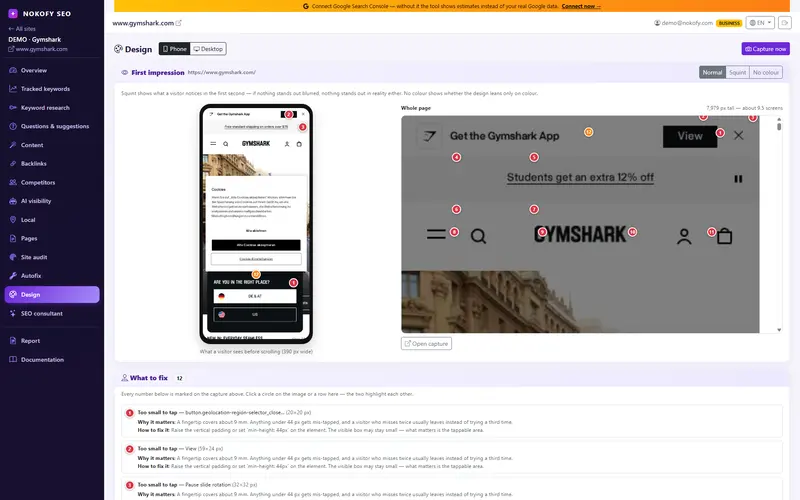
Homepage capture on phone and desktop and a design score 0–100: first impression, contrast, buttons, palette and typography.
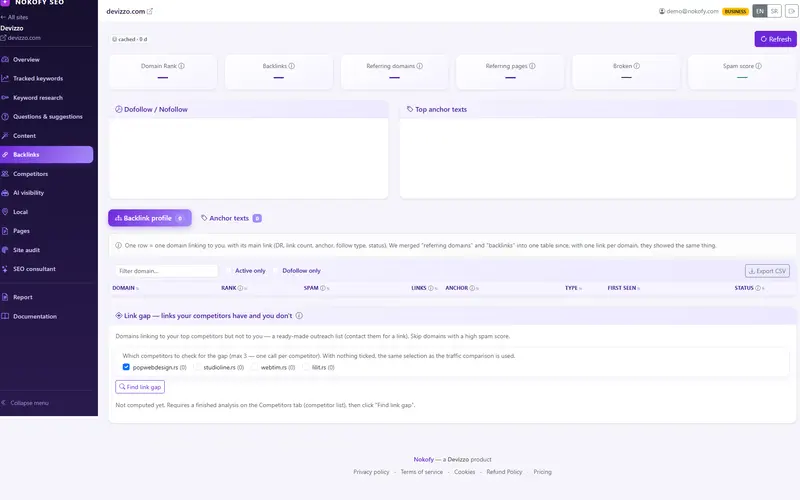
Who links to you, who has stopped, and where the opportunities your competitors already use are.
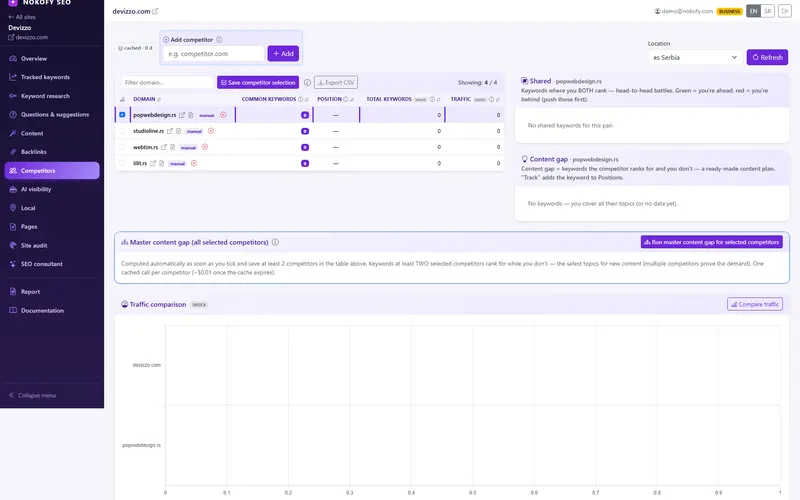
The tool finds your competitors itself and shows what they rank for and you don't.
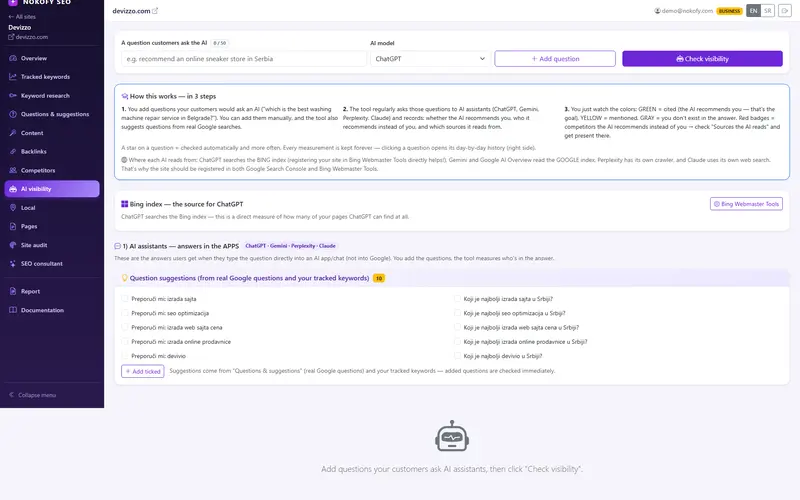
Whether ChatGPT, Gemini, Perplexity and Claude mention you when a customer asks for a recommendation — and who they recommend instead of you.
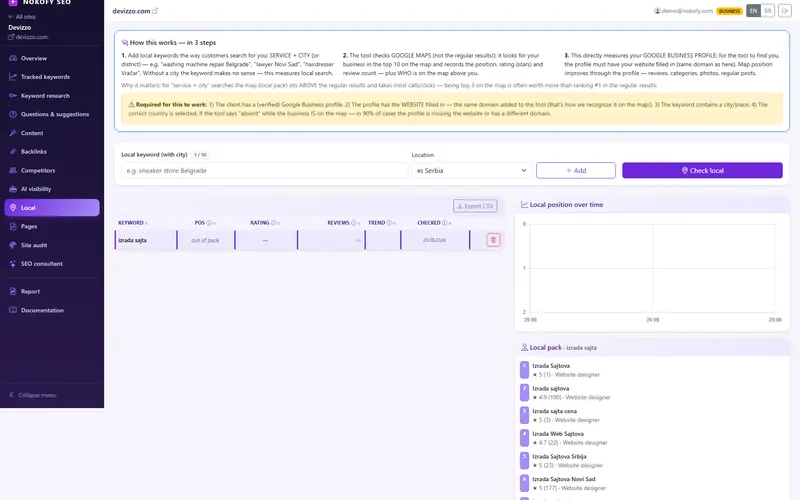
Positions on Google Maps for “service + town” searches, where the map sits above the ordinary results.
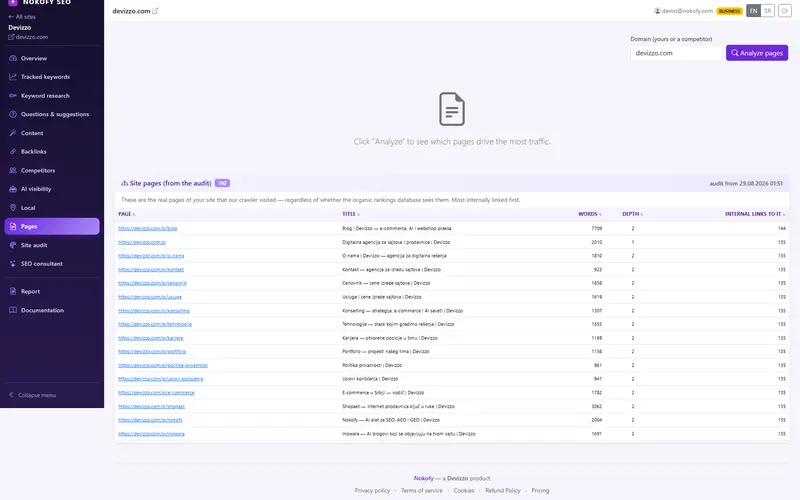
Which page brings in visitors and which one just sits there — and whether Google has indexed it at all.
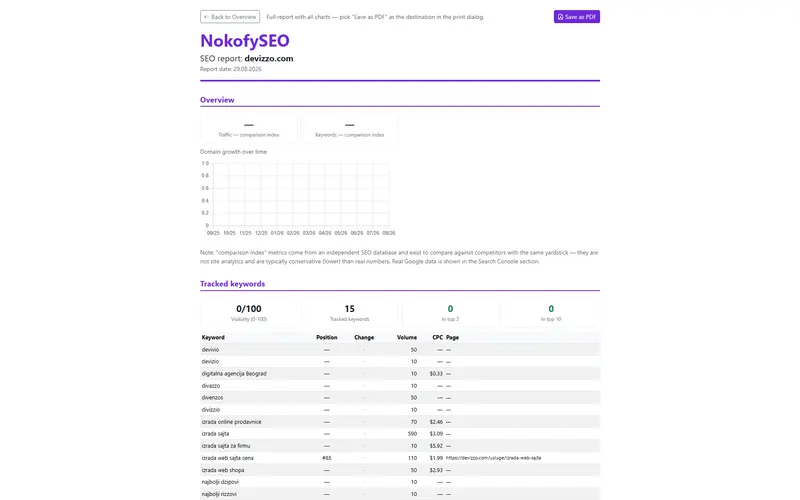
A report with your name and your colour, without a single new API call and without a surcharge. And with it, an explanation of what every column means.
Checklists and monitoring
The tool doesn't just show you numbers but a list of concrete moves — sorted by what returns most for least effort. Beside every item it says why it matters and how to fix it.


The e-commerce checklist alone carries 461 checks — comfortably more than anything else on the market.
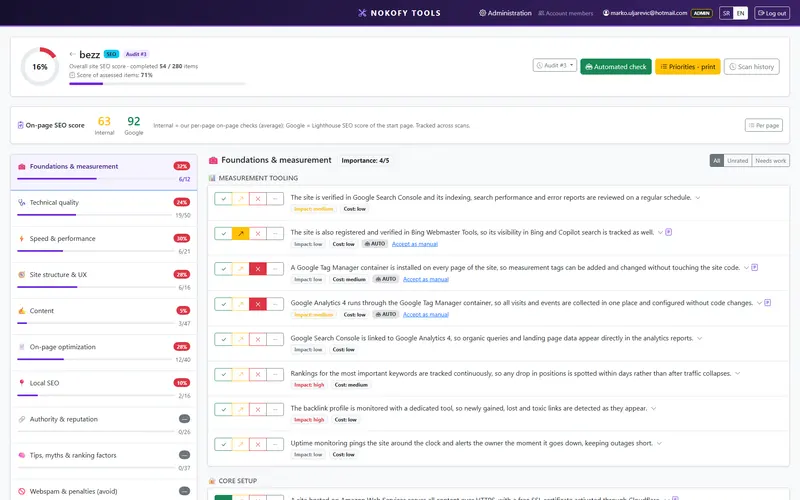
280 checks across 10 areas — from technical quality to content and authority, with a repair plan at the end.
Read more →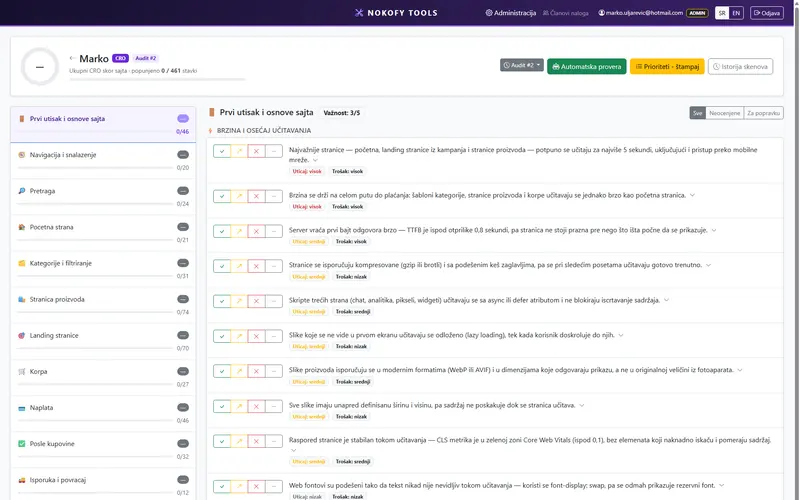
461 checks across 15 areas — from first impression and search to basket, checkout and what happens after the purchase.
Read more →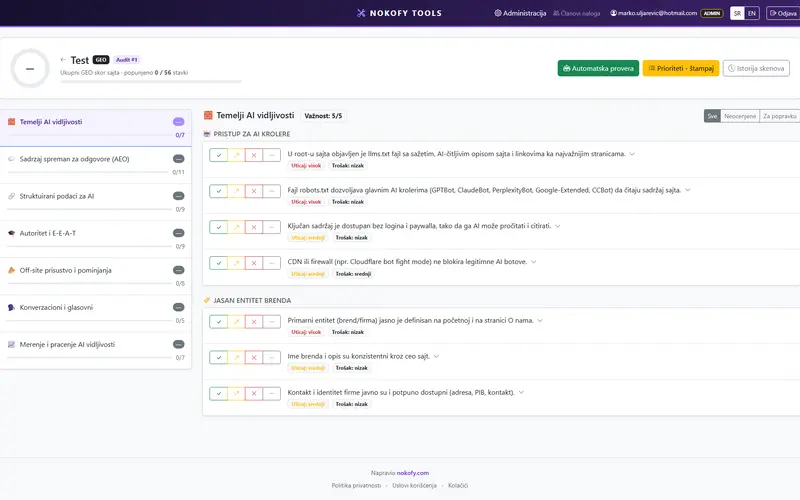
56 checks across 7 areas — how to make your site the source an AI pulls its answer from, rather than a page it skips.
Read more →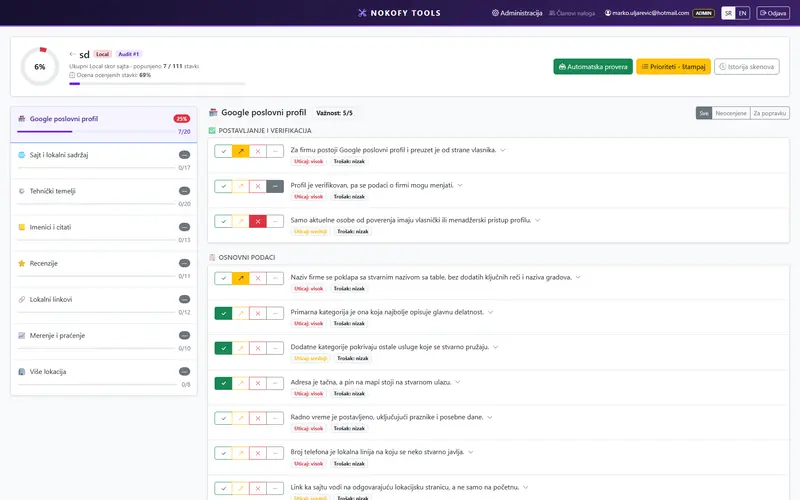
111 checks across 8 areas — business profile, local content, directories, reviews and tracking results.
Read more →The same checklists per client — Email, SMS, Viber and WhatsApp get projects just like sites do. You paid for the visitor to arrive; the channels are there to keep them.
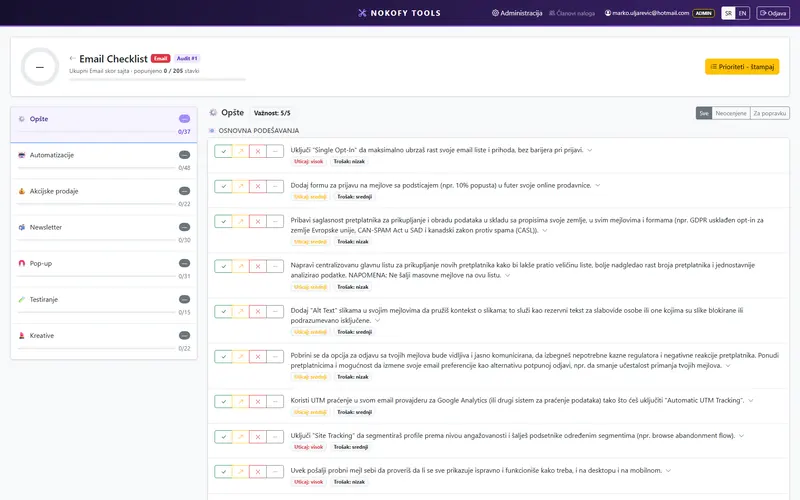
205 checks across 7 areas — from automations and newsletters to pop-ups, testing and creative.
Read more →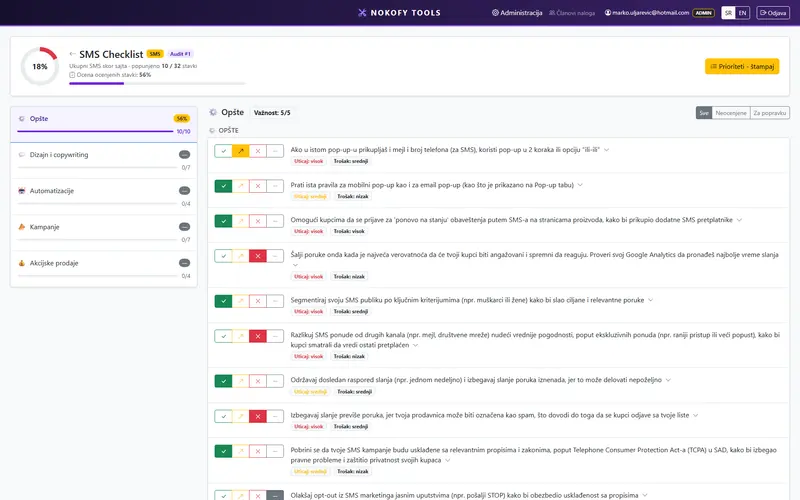
32 checks across 5 areas — consent, writing the message, automations, campaigns and promotions.
Read more →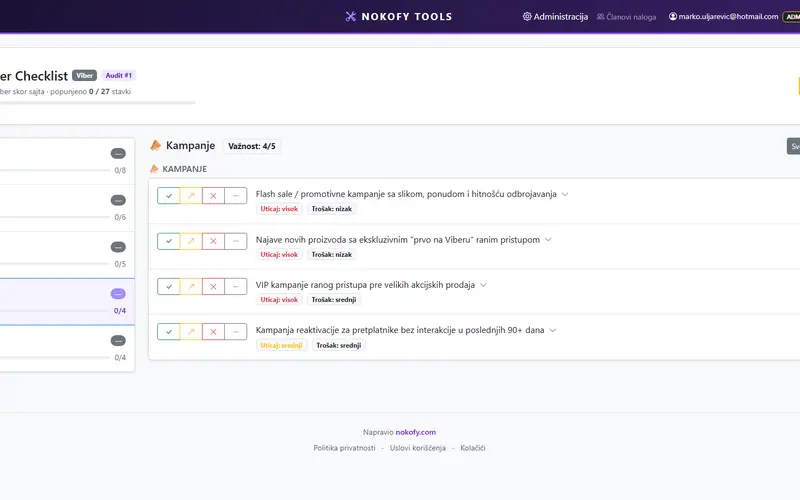
27 checks across 5 areas — consent, message design, automations, campaigns and account quality.
Read more →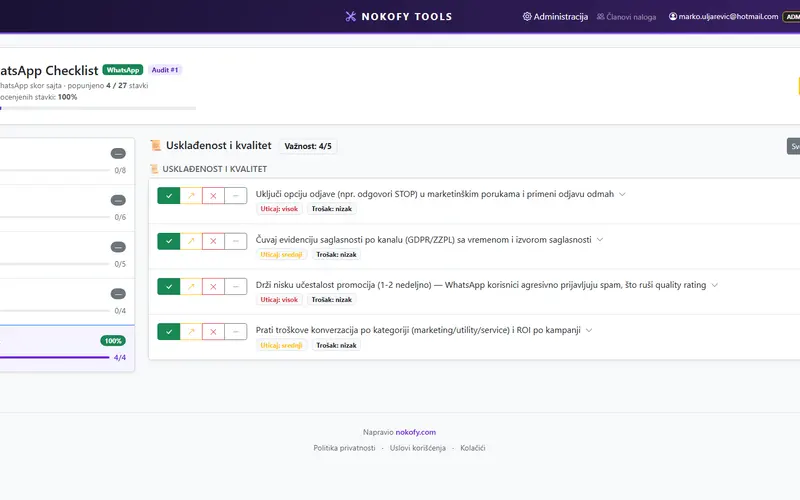
27 checks across 5 areas — consent, business profile and messages, automations, campaigns and account quality.
Read more →The official list of changes and incidents at both Google and Bing, on a timeline: when a change started, how long it lasted and which part of search it hit. When your traffic drops, this is the first place you check whether the cause is at your end or theirs.
Read more →Official announcements from Google and Bing plus what the industry is reporting, sorted by urgency and by area. No reading ten blogs — you see only what concerns you, and only once more than one source confirms it.
Read more →Where most people get stuck
You know you're supposed to “do SEO”. You've probably already tried one of these — and each time you were left with the same feeling: you're paying and you can't see what's happening.

Reports arrive that you don't understand, and you still don't know what is actually being done to your site or when it's supposed to show.
One for keywords, one for positions, one for writing. You open two hundred reports and don't know which one matters. And somebody still has to write the text for the site.
You pick topics by feel. A month passes, there's no traffic, and you don't know whether the topic was wrong, the text was weak or the site is technically neglected.
All three situations share the same thing: you have no reliable tracking, so you don't know whether anything is moving at all; you have no real analysis, so you don't know what on the site is holding you back; you don't know what questions your customers want answered — and even when you find out, there's nobody to write the answers.
How Nokofy solves exactly that
Other tools give you one part of the job. Nokofy runs all eight steps — from the technical audit and the largest checklists on the market, through the real questions and the finished article, to measuring whether publishing changed anything. And then it starts again, with better data.
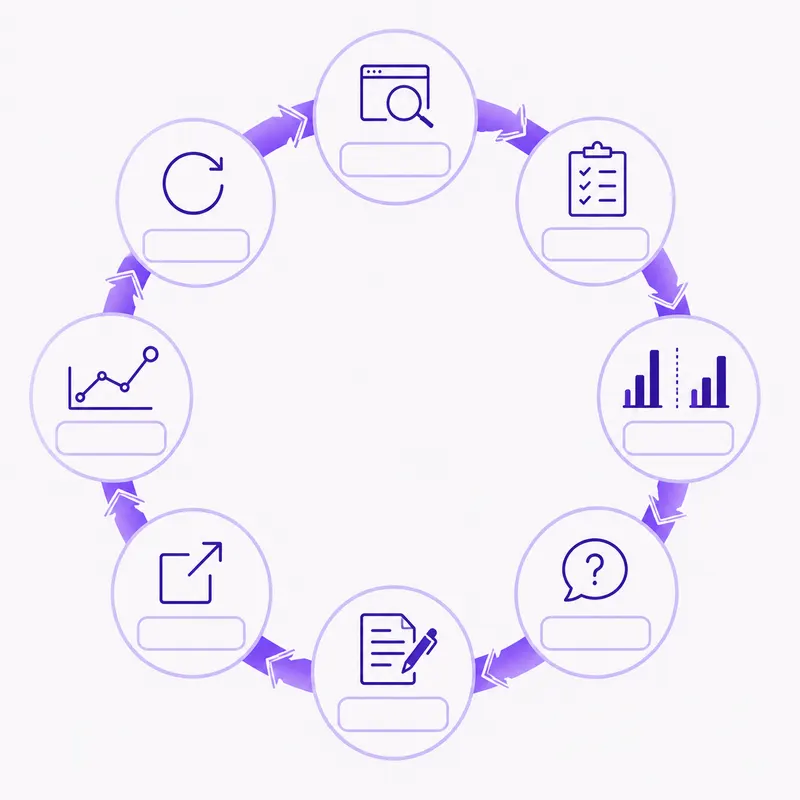
Our crawler goes page by page and returns around 70 types of finding: broken links and where they come from, titles and descriptions measured in both characters and pixels, missing structured data, redirect chains, orphan pages, security headers. At the end there's a quality score from 0 to 100 and scores across nine areas.
The largest checklists on this market — 908 items for the site and 291 for marketing channels. The e-commerce checklist alone carries 461 items, comfortably more than anything else out there. Beside every item it says why it matters and how to fix it, and the whole thing produces a report you can send to a client.
We compare you with your competitors on shared keywords and pull out the content gap — topics they rank for and you have nothing on. With it comes the whole backlink profile, the link gap and a list of links they got and you didn't.
You type in one keyword from your business and get the real questions people are typing — from autocomplete and from the “People also ask” block — with monthly search volumes and cost per click. One keyword easily yields over five hundred topics, from a database of ours that grows every day.
It doesn't come out of one prompt: first the structure, then the introduction, then each section separately, then the common questions and the conclusion. That's why the text holds its topic instead of going in circles. Each one passes six checks and gets an SEO score across eleven items — and it's written for all three kinds of search: SEO, AEO and GEO.
The article arrives finished on the “Content” tab — with a title and description for search, structured data, an FAQ block, images and internal links. You read it, polish it in the editor and put it on the site. Nothing goes out without your decision.
The keyword from the published article goes into rank tracking. Alongside it we track real clicks from Search Console and Bing, speed from real visits, AI visibility across four models and how competitors move — so you can see whether the effect is real or coincidence.
When an article starts to lose its strength, the tool tells you and refreshes it: it rewrites the key parts and updates the date. A new audit and new checklists go into the next round — and everything starts again, just from a better place.
And then round again. That's the difference between a tool that tells you there's a problem and a tool that fixes it.
Why Nokofy
Not all of them are equally obvious at first glance, but each one changes how much work is left to you.
We go through the site down to the smallest errors: around 70 types of finding per page — broken links and where they come from, titles and descriptions measured in both characters and pixels, missing structured data (LocalBusiness, FAQPage, BreadcrumbList, ItemList), redirect chains, orphan pages, click depth, security headers, certificate expiry, image formats and AEO readiness. All of it cross-checked against real clicks, so you fix what is costing you first.
Over 1,200 checks: 908 for the site and 291 for marketing channels. The e-commerce checklist alone carries 461 items across 15 areas — larger than anything offered by tools you pay far more for. Beside every item it says why it matters and how to fix it, and progress is remembered per site and per client. Try them free — neither Ahrefs nor Semrush nor Surfer has them.
There are tools that show what people ask but don't say how often it's searched. There are tools with numbers, but they pull questions from an archive instead of from live search. Nokofy does both — and on top of that builds its own bank of questions and suggestions, today over ten million records, topped up every day. For a keyword already researched, the answer arrives instantly and at no new cost.
We check whether ChatGPT, Perplexity, Google AI and Copilot mention you when somebody asks about your service, and how they describe you. With the tools that have it at all, this is a separate add-on of $71 to $89 a month. Here it's in every plan, including the free one.
Fourteen sections you choose yourself: positions, real Search Console data, the audit with its quality score, checklist results with progress by area, backlinks, competitors, AI visibility, local search, opportunities and customer questions. With your name and your colour instead of our branding, without a single new API call and without a surcharge — elsewhere a white-label report is a separate plan.
Email, SMS, Viber and WhatsApp aren't a footnote but 291 checks across four checklists, with projects per client exactly like sites. No SEO tool has this — and you already paid for the visitor to arrive, so it's only fair to keep them.
With the competition: the data is one subscription, the writing a second, AI visibility tracking a third, reports a fourth. Here it's one account and one invoice — and no screen is locked, not even on the free plan.
The tool runs in English and Serbian, search is run for local Google domains as well as the big markets, and articles are written in 48 languages. A language gets added when it's needed. The biggest AI writing tool in the world supports eight.
Every analysis that costs something has its price written out before you start it, and the account keeps a log of every call: what was run, when, for which site and what it cost. No hidden add-ons and no charge per article.
The free plan isn't a demo with three screens: all sixteen tools, every checklist and the full audit work from day one, just in smaller quantities. No card is asked for and there's no deadline.
Comparison

| Tool | Real questions | Writes the article | Publishes | Tracks position | Checklists | Technical audit | Languages | Price |
|---|---|---|---|---|---|---|---|---|
| Nokofy | yes | yes | yes | yes | 1,200+ | most detailed | 24 | $39 |
| Semrush | partly | second subscription | yes | yes | no | detailed | 8 | $139 |
| Ahrefs | partly | no | no | yes | no | detailed | English-first | $129 |
| Surfer SEO | no | yes | yes | no | no | no | 11 | $99 |
| SE Ranking | partly | yes | yes | yes | no | basic | 10 | $103 |
| Ubersuggest | partly | no | no | yes | no | basic | 7 | $99 |
| AI writers | no | yes | sometimes | no | no | no | varies | $99 |
Here the article arrives finished on the “Content” tab and is ready to publish: you copy the finished HTML, the plain text or the structured data and put it on the site. The review before publishing is deliberately yours — you keep control over what goes on the site. On top of that comes what no other column has: over 1,200 checks in the checklists and the most detailed technical audit in this price range.
See the detailed comparison with each tool →Content generator
You don't get five paragraphs of general text. You get an article that's ready to go on the site.
You edit all of it here, in the editor — we don't send you off to any other site.
Site audit
You don't get a list of three tips. You get a quality score and a repair plan sorted by what is actually costing you.
The crawler pauses two seconds per page and respects your site's rules — it doesn't load the server and doesn't touch anything. It runs in the background, so you don't have to wait.
See everything the audit checks →Pricing
Every tool is in every plan — only the quantities differ.
Early Bird: −40%
To see whether the tool suits you, on your own site.
$0 no card
For regular work on one to five sites — content, tracking and growth.
$65 −40%
$39 a month
For agencies and shops with several sites and clients.
$165 −40%
$99 a month
No card for the free plan · No charge per article · No add-on for reports · Extra credits available when needed · Full pricing →
No. Google penalises worthless content, whoever wrote it. Our texts answer questions people genuinely ask, have the structure search expects, and you review and polish them before they stay on the site. That's exactly why there's a quality score that stops a weak text.
No. That's what the checklists and priorities are for — they tell you what to do next, in order of importance, with an explanation of why.
Yes. Search is run against your country's Google and your language, texts are written in 48 languages, and the tool itself runs in English and Serbian.
The free plan doesn't ask for a card. You try it on your own site before paying anything — one site, two research runs and one article a month.
Yes. You open every article here, change the text in the editor, change the title and description, and copy the finished HTML or plain text.
Create an account, add your site and type in one keyword from your business. You'll get a list of real questions with search volumes. If you like what you see — you stay.
No card · No contract · Cancel anytime