“How long until results show?” is the first question everybody asks, and the only one nobody likes to answer honestly. The answer is: it depends on how badly you started and how hard the competition is working. But there is a schedule that holds in most cases, and it’s worth knowing before you spend three months expecting something that can’t happen.
The first two weeks: the technical things
This is the only part where the result shows almost immediately.
If the site wasn’t in the index at all, if robots.txt was blocking it, if half the pages carried a noindex tag — the fix shows within a few days. Google crawls the site again, the pages enter the index and traffic jumps from zero to something.
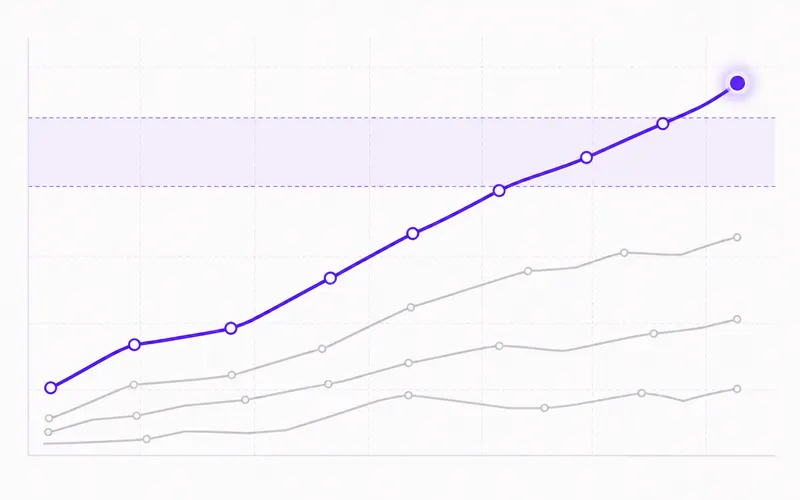
The same goes for titles and descriptions: if you change the title on a page that already appears in search, the change in clicks shows within a week or two. It’s the fastest fix in all of SEO, which is why it’s done first.
What not to expect in this period: positions moving because of new content. A text published yesterday isn’t even properly indexed, let alone ranked.
Months one to three: the first long-tail keywords
New texts start catching long, specific phrases — the ones searched twenty to a hundred times a month that nobody seriously competes for.
This is the most important period and also the one where most people give up, because the numbers look miserable: five visits here, twelve there. But that isn’t small traffic — it’s the first proof that the mechanism works. If nothing appears on a single long phrase in three months, something is set up wrong and you should stop and check.
How to tell whether it’s going the right way: in Search Console, watch the number of different queries you appear for, not the number of visits. If three months ago there were 40 queries and now there are 180, the site is growing — even while traffic is still small.
Months three to six: mid-range keywords and the first real traffic
Now you see whether the work was worth it. Pages that sat in 30th place for months start entering the top ten, because Google has gathered enough signals — people open them, they stay on them, the site is stable.
This period usually also brings the first jump that looks like a fluke: traffic doubles in a week without a single change. It isn’t a fluke — it’s the moment when several pages cross from the second page of results to the first.
Months six to twelve: competing for the main keywords
The keywords people genuinely look for you by — the ones with the highest volume and the clearest buying intent — come last. For those you need content, time and links from other sites.
Honesty matters most here: for some keywords you will never be first, and that’s fine. A shop with five products won’t beat a site with ten years and a thousand pages on the word “furniture”. But it can be first for “fitted kitchen Croydon price” — and that’s the keyword that brings work.
What speeds it up and what slows it down
Speeds it up:
- a site that has already existed for a few years, even if neglected
- Search Console connected from day one (without it you’re measuring blind)
- regular content — two texts a month across a year do more than twenty at once in January
- fixing technical errors before writing, not after
Slows it down:
- a new domain with not a single link
- an industry where the competition has been doing SEO for years
- writing about topics nobody searches for — the most expensive mistake, because it only shows after three months
- changing strategy every month

When it’s time to give up
Not on SEO — on an approach that isn’t working. If six months have passed and all three of these are true at once:
- the number of different queries in Search Console isn’t growing,
- no new page has entered the top fifty,
- the technical audit shows no serious errors,
then the problem isn’t patience but topics. You’re probably writing about what interests you rather than what people search for. That can be fixed in one afternoon — ask Google what is actually being searched and build the plan out of its answers.
In short
| Period | What shows |
|---|---|
| 2 weeks | technical fixes, title changes |
| 1–3 months | the first long phrases, growth in the number of queries |
| 3–6 months | mid-range keywords enter the top ten, the first real traffic |
| 6–12 months | the main keywords, if there’s content and there are links |
The only way for this not to be guesswork is to measure from day one. If you start tracking positions in the third month, you have nothing to compare against — and you’ll never know whether it grew or just felt like it.