A few years ago, somebody looking for an air conditioning engineer opened Google and looked at the first three offers. Today they increasingly open ChatGPT and write: “who should I call for air conditioning service in Manchester”.
The difference is enormous. Google shows ten links and you choose. AI gives you one to three names and that’s it. If yours isn’t among them, you don’t exist in that search.
This change is happening faster than most companies realise, and the good news is that the rules are simple and hardly anyone is applying them yet.
First understand where AI gets its data
This is the part almost nobody knows, and it changes the most:

- ChatGPT searches the Bing index. Not Google. If your pages aren’t in Bing, ChatGPT can’t find them even if it wanted to.
- Gemini and Google AI answers read the Google index.
- Perplexity has its own crawler.
- Claude uses its own search.
The practical consequence: Bing Webmaster Tools isn’t optional. Registration takes five minutes and is free, and the site is added with one click through the import option from Google Search Console. If you haven’t done it, do it today — it’s the biggest effect for the least time invested in this whole article.
Check that you aren’t accidentally blocking AI bots
Many sites block bots they don’t recognise in their robots.txt. The problem is that the list often ends up including:
GPTBot— OpenAIClaudeBot— AnthropicGoogle-Extended— Google, for AI answersPerplexityBot— Perplexity
If you block them, your content doesn’t enter what those models learn from and base their recommendations on. Open yoursite.com/robots.txt and look. If you see any of these names next to Disallow, think carefully — blocking only makes sense if your content is a trade secret.
Write so the answer can be extracted
AI doesn’t read text the way a person does. It looks for a clear answer it can quote. So:
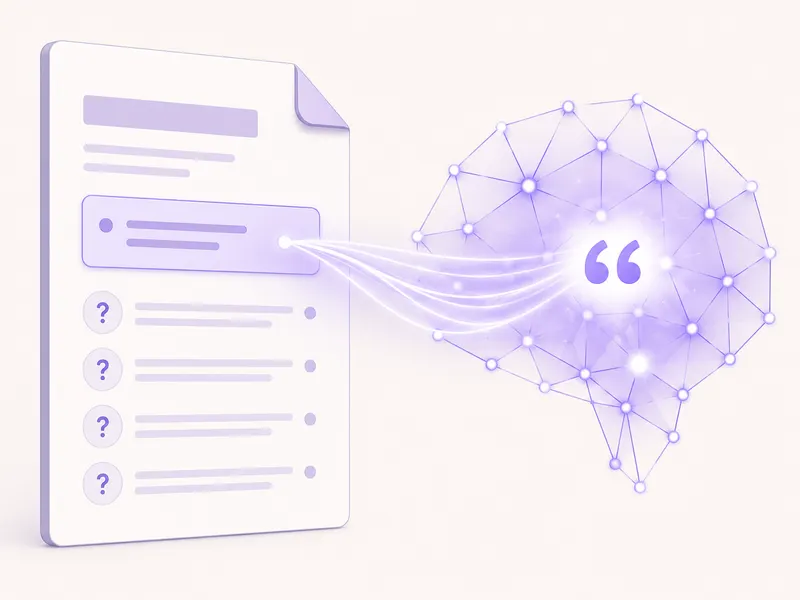
Make subheadings questions. Instead of “Our services”, write “How much does air conditioning service cost”. That way the model sees the question and the answer one below the other.
Answer immediately, then explain. The first sentence below the subheading should be the whole answer in two or three sentences. The details come after. If the answer only arrives in the fifth paragraph, the model probably won’t extract it.
Use lists and tables. Structured content is easier to extract than a wall of text.
Add an FAQ section. Five or six real questions with short answers at the bottom of the page — it’s a format both Google and AI models love.
Be concrete with numbers. “Competitive prices” means nothing. “Service from £85, an engineer on site within 24 hours” is something a model can pass on.
There’s also structured markup
Structured data (schema) is the invisible part of a page that tells machines what is what: this is an article, this is a question, this is an answer, this is a company with this address and this phone number. For AI visibility the useful types are FAQPage, Article and LocalBusiness.
If you use WordPress, plugins do it for you. If somebody else builds your site, ask for it to be added — it’s half an hour of work.
You aren’t visible only through your own site
This surprises most people: when AI recommends companies, it often cites other people’s sites — portals, directories, forums, industry blogs. If somebody else mentions you in an article about “the best air conditioning engineers in Manchester”, you enter the recommendation even though the model never opened your site.
That’s why it’s worth being present where your industry is written about: local portals, trade associations, quality directories, guest articles.
And finally — measure, don’t guess
Everything above is an assumption until you check. And checking is simple: write five questions your customer would actually ask and put them to the models. Then look at:
- whether they mention you at all
- whether they cite you as a source or just mention you in passing
- who they recommend instead of you
- which sites they pull the answer from
That last one is worth its weight in gold: the list of sites AI reads in your industry is also the list of places you should be present on.
Nokofy has a dedicated screen for this — you add the questions, the tool puts them to four models regularly and shows you whether you’re cited, merely mentioned or absent, plus the competitors who are there instead of you. See how AI visibility tracking works.
In short, in order of importance
- Register the site in Bing Webmaster Tools — without it, ChatGPT doesn’t see you.
- Check that
robots.txtisn’t blocking AI bots. - Turn subheadings into questions and put the answer straight underneath.
- Add an FAQ section with real questions.
- Add structured data.
- Be present on the other sites AI reads too.
- Measure once a month and watch the trend, not a single reading.
None of this is expensive or complicated. The only real obstacle is that most companies still don’t know they need it — which is exactly why it pays off now.